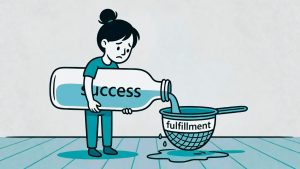
Most people assume that intelligence protects them from making poor choices. If you’re smart enough to analyse complex problems at work, surely you can figure out your own life.
Intelligence doesn’t make you immune to poor decisions. It just gives you better tools to justify them. When decisions involve your identity, status, or deepest fears, your intelligence works against you—building more sophisticated rationalisations for what you’ve already decided emotionally.
When Expertise Becomes Blindness
Some years ago, a senior manager in my organization had built her reputation on data-driven decision-making. When her team underperformed, she could analyse the problem ruthlessly: wrong people in wrong roles, misaligned incentives, poor communication structures. But when it came to her own role? Different story entirely.
She, as well as the people on her team knew she was burning out. All the symptoms were there: declining health, strained relationships, work she used to enjoy now feeling drudgery. Yet she stayed, and she had brilliant reasons why: the company needed her during this transition, her successor wasn’t ready, leaving now would damage her professional reputation. All true of course. But also, all irrelevant.
How Intelligence Backfires
There are four ways smart people sabotage their own decisions:
1. Constructing Narratives That Serve Emotional Needs
Smart people excel at constructing narratives that feel logical but serve emotional needs. You tell yourself you’re being strategic when you’re actually being scared. You frame avoidance as patience. You mistake familiar discomfort for acceptable risk.
The sunk-cost fallacy is a perfect example. Everyone knows the principle: you’ve invested time, money, or effort into something, so you keep going even when it’s clearly not working. Smart people understand this intellectually. They still fall for it. I’ve watched executives with MBAs justify staying in roles they hate with arguments so sophisticated they’d convince a board of directors—when anyone else would simply say “I don’t want to waste the last five years.”
2. Finding Evidence for Predetermined Conclusions
As Daniel Kahneman explains in his book “Thinking, Fast and Slow”, smart people are exceptional at finding evidence that supports predetermined conclusions. Your brain commits to a position before your conscious mind catches up. Then you go looking for data, and unsurprisingly, you find it. Confirmation bias doesn’t disappear with a higher IQ—it just gets more articulate.
3. Creating False Equivalencies Between Different Decisions
Smart people also create false equivalencies between different types of decisions. You’ve made good decisions in one domain—technical problems, financial analysis, project management—so you assume the same approach works for personal choices. Professional decisions often benefit from detachment and systematic analysis. Personal decisions require something closer to self-awareness, and that’s a completely different skill.
4. Over-Explaining Decisions That Should Be Final
I know this one from experience. You know a situation or relationship is wrong for you. You want out. But instead of simply stating your decision, you feel compelled to give the other person a rational explanation they can understand and use. You’re trying to “do right by them.”
What actually happens: you hand them the exact arguments they need to negotiate. They chip away at your decisiveness using the very reasoning you just provided. “But we can change that.” “What if we tried this instead?” You meant to close a door. You opened a window for debate.
The smarter you are, the more sophisticated your explanations—and the more ammunition you provide. Sometimes the right answer is simply: “This is no longer what I want. I’m moving on.” Let the other person solve their own problems. Out means out.
Breaking Through the Impasse
Intelligence is brilliant at solving problems where the answer exists outside you. What return will this investment generate? What’s the most efficient route? How do we optimise this process?
Personal decisions aren’t that kind of problem. The answer lives somewhere tangled up with your perception of yourself and the world around you, your guiding principles and values, your practical and aspirational objectives in life. Your intelligence can analyse these things endlessly, but in the end it’s those deeper lying emotions, intuitions—your gut feel—that truly drive decisions.
This is where most smart people get stuck. You know something needs to change. You can see the problem clearly. You might even have a list of techniques to help you decide. But techniques don’t solve the real issue – they just give you more sophisticated ways to avoid it.
The breakthrough happens when you have someone outside your own head who can help you see what’s really driving your choices. Not to give you answers, but to help you distinguish between genuine concerns and elaborate justifications. To spot when you’re being strategic versus when you’re being scared. To recognise which arguments actually matter and which ones are just protecting you from the discomfort of change.
That’s the work I do with clients – helping you figure out what you actually want, not what you think you should want or what you’ve convinced yourself makes logical sense. If you’re finding yourself building sophisticated arguments for decisions that don’t feel right, we should talk. Message me or book a free Discovery Session using the button at the top.
Resources
Kahneman, D. (2011). Thinking, Fast and Slow. Farrar, Straus and Giroux.