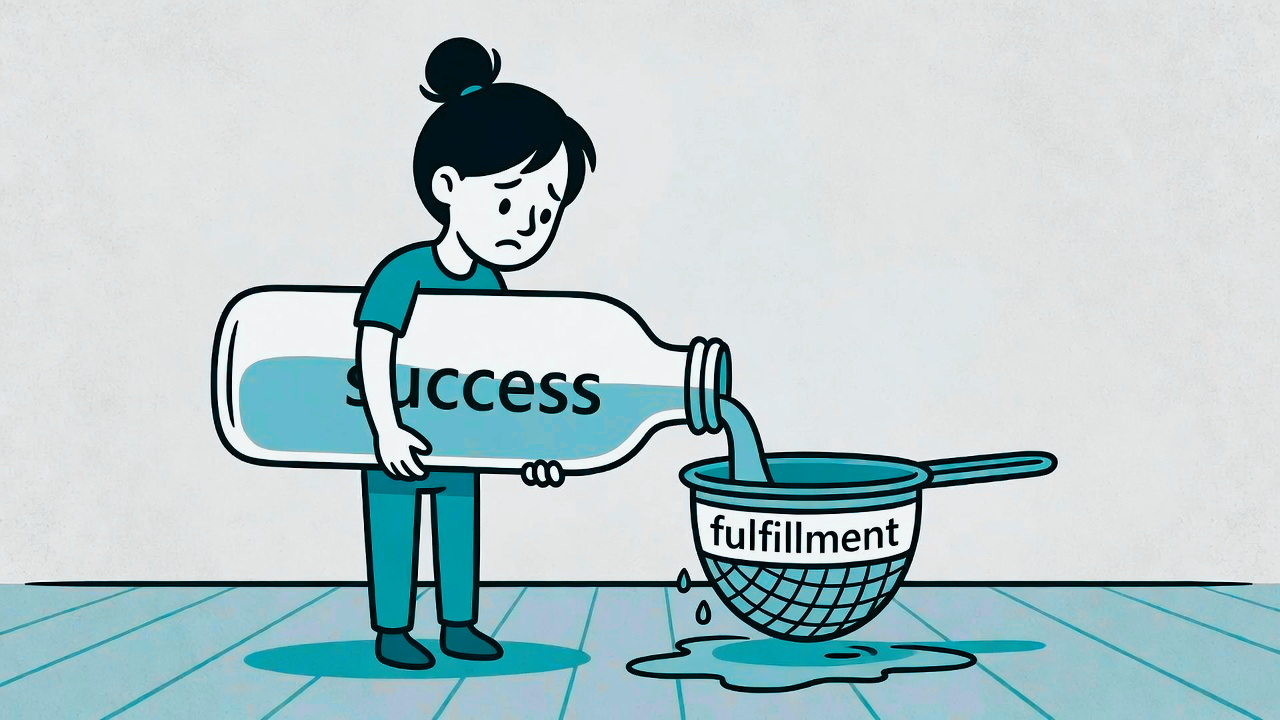
The promise of success
Success comes with a clear promise. Work hard, perform well, hit the milestones, and life will eventually feel settled – not just financially or professionally, but emotionally. Respect, security, and fulfilment are expected to follow.
This promise is reinforced everywhere. Education systems reward achievement early. Organisations promote those who deliver results, often regardless of how those results are achieved.
Social status tracks visible markers of success: role, income, productivity, influence. These signals are easy to recognise and compare. They define what it means to be “doing well”.
None of this is inherently wrong. Success is useful. It provides options, safety, and agency. It reduces some forms of stress.
The problem starts with a quieter assumption: that success will convert into something deeper later on. That once you have achieved enough, meaning, contentment, and balance will follow automatically.
Many life choices are made in service of that belief. Long hours, delayed rest, postponed relationships, and chronic busyness are tolerated as temporary costs on the way to a more fulfilling future.
The quiet mismatch many people experience
For many people, that conversion from success to fulfilment never quite happens.
On paper, things look fine. Careers progress. Lives are busy and outwardly full. There is competence, recognition, often financial security. Yet underneath sits a sense that something is missing. Not dramatic unhappiness, but a low‑grade dissatisfaction. A feeling of running efficiently in the wrong direction.
This mismatch is confusing because there is no clear problem to point to. Work is going well, income is stable, relationships are intact, health is mostly fine. Complaining feels out of place, and gratitude feels expected.
The discomfort gets turned inward and treated as something being wrong with you. If success is meant to fulfil you, then not feeling fulfilled looks like your own fault.
Many people respond by doubling down. More effort. Higher targets. Less space. The logic is familiar: if the payoff has not arrived, the answer must be to push harder. Over time, this amplifies the tension it is trying to resolve. Life becomes narrower and faster, with everything turned into a means to an end.
What a large global study on flourishing reveals
In 2025, the Global Flourishing Study (https://globalflourishingstudy.com/) examined how people in very different countries experience their lives across areas such as health, relationships, meaning, and material security — not just income or happiness scores.
It found that measures linked to success such as income, productivity, drive, and future focus are only weakly related to how people experience their lives.
Some highly disciplined, high‑performing societies score surprisingly low on lived flourishing. Meanwhile, several less affluent countries report stronger social connection, clearer sense of purpose, and better perceived mental health.
This does not mean that prosperity or ambition are irrelevant. It shows that success and flourishing are different things, and they are shaped by different things.
Flourishing depends on things that are harder to measure or manage deliberately: close relationships, a sense of meaning, psychological health, character, and belonging. These do not automatically improve as a by‑product of achievement.
When success takes centre stage, it pushes these parts of life aside. Time, attention, and energy are finite. When they are taken up by performance and progress, there is less room for the parts of life that make success feel worthwhile.
Success as a tool, not a destination
Seen this way, success is expected to do a job it cannot do. It is treated as a source of meaning, instead of a useful tool.
Success works best when it serves something else: a life with enough stability for relationships, enough space to reflect, and enough freedom to act on what matters. When it becomes the destination in its own right, it tends to flatten the very experiences people hope it will deliver.
Many people keep chasing success without ever stopping to ask what else is important that they’ve been neglecting.
If you want to take a pause in the middle of constant pushing, maybe start with a simple question: If nothing had to change right now, what would I still want to look at? Not to fix or optimise, but to notice. What feels thin, missed or ignored?